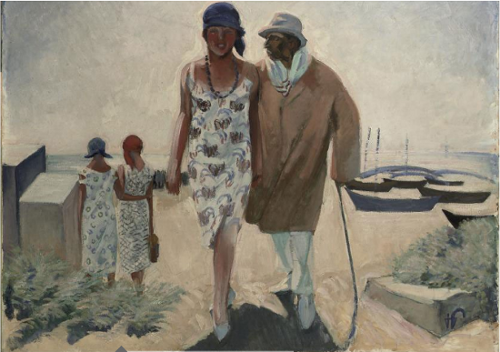
Blossoming Love on the Beach of Gray, France
Year: 1895
Description: This piece was dated by Christie's 19th Cetury art department. The signature is consistent with the period but the rest of the piece seems later. His technique is more refined and the swim fashion seems later than the date. For now we'll tentatively catalog it at 1895.
Provenance: Private collection
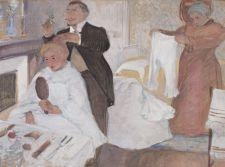
A Young Woman And Her Haircut
Year: 1895
Description: Keeping one's appearance was a full-time job for upperclasses in the Belle Epoque. A bad hair day was no trifle matter. Here a hair dresser makes a house call in order to refine the lady's appearance while the inhouse staff prepares her attire. It was not uncommon for a lady of such standing to change her appearance several times a day. Meanwhile, in the squalor of Paris, Alphonse Mucha continues his role as the proverbial starving artist.....
Provenance: Artcurial Briest-Poulain-F. Tajan

Promenade de l'enfant
Year: 1897
Description: Oil on canvas, signed on the back.
Provenance: Private collection, circa 1897
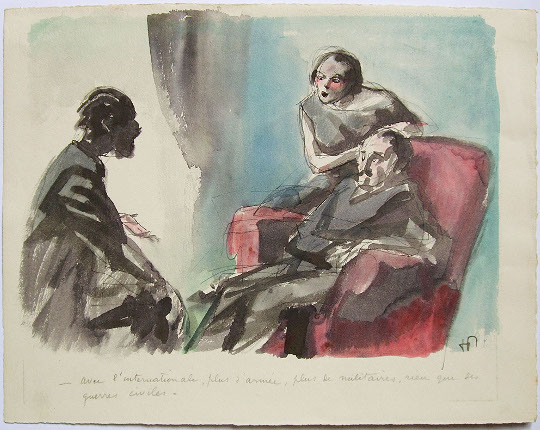
Nothing But Civil Strife
Year: 1898
Description: Jules Guesde sits in the parlor of a bourgeoisie home. He argues his side of a rift that divided the Socialists in the late 1890s. Guesde felt they should not comprimise with the capitalist government. They must oppose the bourgeoisie at all costs, "With the internationale, no more army, no more military, nothing but civil strife." (Avec l'Internationale, plus d'armee, plus de militaires, rien que des guerres civiles)
Provenance: Private Collection
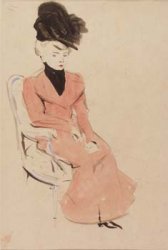
Elégante au manteau rose
Year: 1899
Description: A portrait of a lady in an elegant pink coat. Her detailed appearance contradicts the look of impatience on her face. For the leisured class this may well have been considered "work" and she reveals her displeasure with the affair. Fortunately, there are little people to assist with a wardrobe. Unfortunately, they can't pose as their employer as she sits for the artist. Hermann-Paul relied on this soft color palette often at the turn of the 20th Century.
Provenance: L'Estampe Originale circa 1899

Canal In Venice
Year: 1900
Description: Oil on canvas
Provenance: Private collection, circa 1900

The Lovers.
Year: 1900
Description: This piece owes much to the Nabis and Cézanne in particular. Oil on canvas
Provenance: Galerie L'Ergastere, Paris
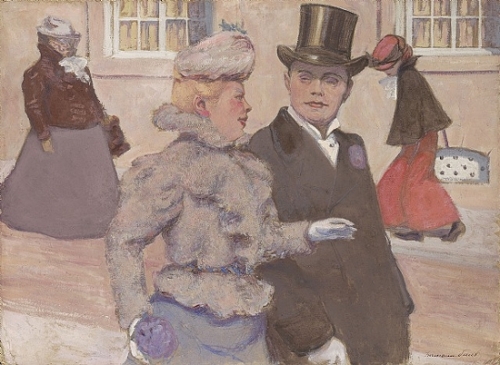
Sur Les Boulevards
Year: 1900
Description: On the boulevard we find this interesting piece. The couple in the foreground are executed in a post-impressionistic style, stylistically consistent with the Intimistes. Note the contrast between them and the people on the far side of the street. They are oil renditions of Hermann-Paul lithographs, characters he created for the humor magazine Le Rire. With this reference to contemporary culture, he creates a pop aesthetic a half century before Litchtenstein and Warhol popularized the form.
Provenance: L'Estampe Originale
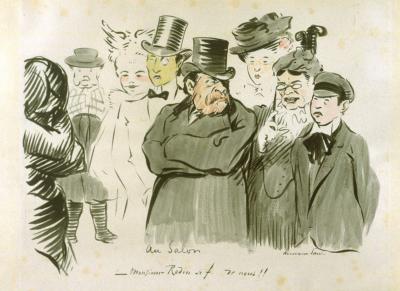
At the Salon
Year: 1900
Description: The caption reads, "Monsieur Rodin se f(outre) de nous!!" (Mister Rodin is making fun of us).
The Société des Gens des Lettres commissioned Rodin to create a monument to Balzac in 1891. The artist struggled to find the right note and finally exhibited the piece in 1898. The reaction was quite negative. The Société rejected it and the press parodied it.
Provenance: Fine Arts Museums of San Francisco
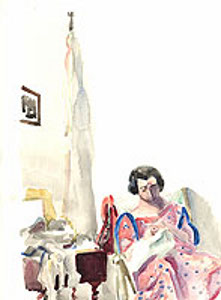
A Woman Sewing
Year: 1904
Description: Around the turn of the 20th Century, Hermann-Paul created work in the intimiste style The term was coined – derisively, it seems – by Édouard Vuillard who used it to describe his own style. Other practitioners include Maurice Lobre, Hughes de Beaumont, Henri Matisse, Rene Prinet and Ernest Laurent. The Intimists first collective exhibition was shown at Henry Grave's galleries in 1905. The exhibition included several works by Hermann-Paul. This work was probably completely prior to that exhibition. Courtesy of FC Fine Art
Provenance: L'Estampe Originale
