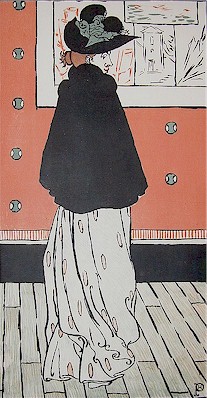
Woman With A Black Hat and Shall
Femme au Chapeau et a la Cape Noire
Year: 1890
Description: This color lithograph is one of the earliest known published works by Hermann-Paul. Its style owes much to Toulouse-Lautrec and the artists around him. Here we see the colors and textures that would define his lithography during the 1890s.
H-P would draw on a stone with lithographic crayon. After the material was fixed to the stone, he washed the whole thing with water. The greasy image repelled the water which dampened the bare stone. Then Hermann-Paul would apply printers ink to the stone. Since water repels grease, the ink sat only on the image area. After the stone was inked, Hermann-Paul would lay paper on the stone and apply pressure with a roller. He repeated the process for multiple colors.
Provenance: L'Estampe Originale
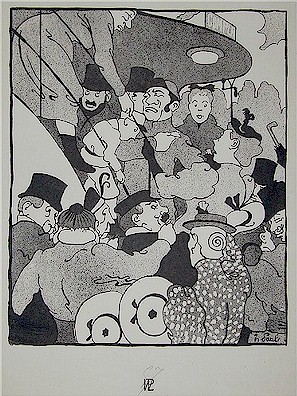
Escargots d'Omnibus
Year: 1893
Description: This color lithograph depicts the nightmares 1890s travel. After nearly two decades of economic expansion, more Parisians were able to travel than ever before. The result was long lines and large crowds.
This work contains lovely texture and whimsical lines. Sure, the artist complains about the nightmare of travel but you'll find yourself chuckling as he recounts his vacation. It's a fine example of 1890s lithographic art. This work appeared in La Escarmouche.
Provenance: La Escarmouche, 24 December 1893
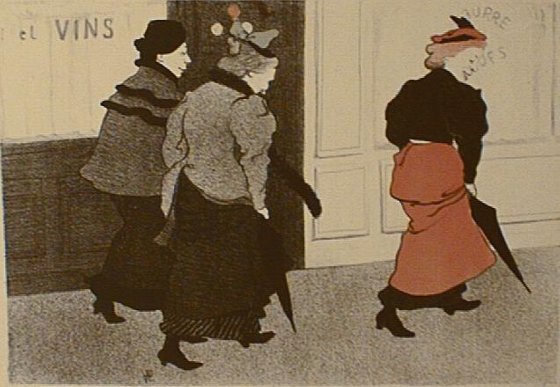
Milliners
Modistes
Year: 1894
Description: Color lithograph, 9-3/4 x 13-7/8 (248 mm x 352 mm) Edition of 100 each signed by the artist
Provenance: L'Estampe Originale
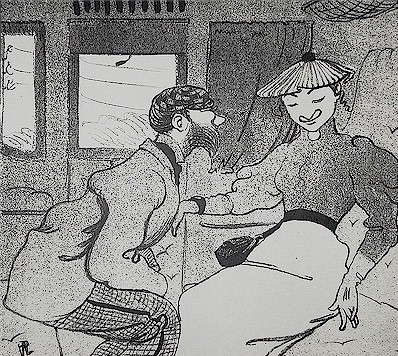
Voyage de Noces (Honeymoon)
Year: 1894
Description: This black and white lithograph features a young couple as they embark by train for a honeymoon.
Provenance: La Escarmouche, 7 January 1894
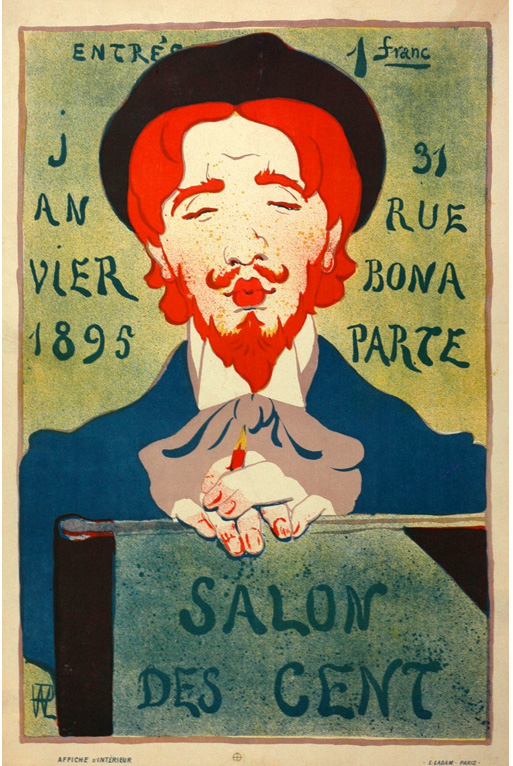
Salon des Cent
Year: 1895
Description: Color lithograph poster for the seventh Salon des Cent
Provenance: La Plume, January 1895
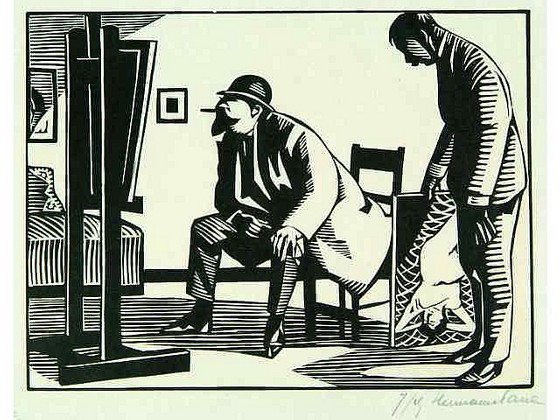
The Amateur
Year: 1895
Description: This work was dated by various auction houses to 1895. If it's accurate, this is a rare and very early wood cut by Hermann-Paul. Because of its rarity, it generally sells for twice as much as comparable prints from the 1920s. It's currently dated in the catalog to 1895. While I can't disprove the auction listings, I have serious doubts about their accuracy.
Provenance: L'Estampe Originale

Les petites machines a ecrire
Year: 1896
Description: Color lithograph on vellum. The work features a stenographers pool of identically dressed young ladies.
Provenance: Planche de l'Album des Peintres Graveurs edite par Vollard
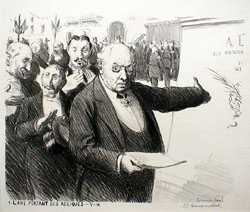
The Ass Carrying Relics
L'âne portant des reliques
Year: 1897
Description:
The original fable speaks of an ass that carries a religious image upon its back. A crowd gathers to view the image and the donkey takes homage as though the attention was focused on him and not the icon on his back. Pride brings him to a standstill and he refuses to budge. The driver beats the beast.
"The world is not so backward that men bow to asses," he exclaims.
The original fable was written by Aesop. In the 17th Century, Jean de La Fontaine produced his own version of the Greek parables. His writings remain in print to this day. Hermann-Paul illustrated the 1897 printing. In H-P's hands, the donkey becomes a jackass, the type person we cannot allow bring progress to a standstill.
Provenance: Private Collection
- Jeffrey Fulmer, Lancaster, PA (2008)
- The Annex Galleries, Santa Rosa, CA (2006)
- L'Estampe Originale
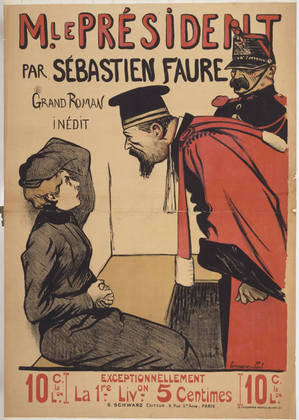
M. Le Président
Year: 1898
Description: Hermann-Paul was a familiar face in left-wing circles during the 1890s. His work appeared in anarchist weeklies and left-of-center newspapers. Here we find a promotional poster for a novel by anarchist Sebastien Faure. It is characterized by a bold red set against yellow and black. The composition draws the eye nicely to the text. circa 1898
Provenance: La Lithographie Nouvelle
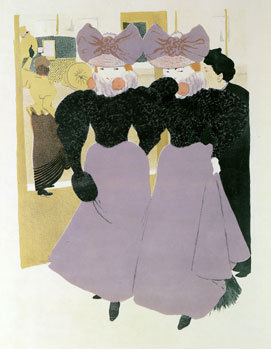
Elégantes sur les Boulevards
Year: 1898
Description: This color lithograph is an iconic poster from Belle Époque France. The yellow background reminds one of Jules Chéret while in the foreground one sees the large blocks of color favored by Toulouse-Latrec. Hermann-Paul adds a bold lilac to Latrec's basic palette and features it prominently in the foreground. It is was a modern print.
Provenance: Cantor Arts Center at Standford University
